


Sebastien Long’s Lodgeur Inc. leases dozens of Houston apartments on a short-term basis, serving business travelers, recovering cancer patients, professional baseball players and people going through divorces or remodeling a permanent home after a storm. They’re not spring breakers or human traffickers, Long says.
His business could be crushed if the Houston City Council passes an ordinance that he maintains is basically useless aside from imposing excessive $275-per-unit annual registration fees, detrimental to someone who deals with multifamily homes.
“We’re looking to continue to grow, but this ordinance could slow us down,” he said. “Uncertainty is a killer.”
As it turns out, residents who have dealt with raucous party houses taking over their single-family neighborhoods also think the ordinance is useless. They say it doesn’t have enough teeth to weed out the bad apples — offsite operators who don’t care about illegal activity or code violations in residential areas.
The Houston City Council is set to vote on the ordinance on Wednesday, March 26. If it passes, some short-term rental operators say they’re contemplating forming an alliance and suing the city.
That’s exactly what Houston officials don’t want. Advocates on both sides of the issue speculate that the reason the ordinance is so watered-down and spent months under review by the city’s legal department is that the municipality wants to protect itself from litigation.
Houston City Council members have said regulating neighborhood short-term rentals is challenging in a city that doesn’t have zoning. Although that doesn’t mean cities with zoning will be any more successful. Dallas and Austin that have crafted zoning ordinances to ban party houses in single-family neighborhoods and have been sued for their efforts.
At-Large Houston City Council Member Julian Ramirez said in a December Quality of Life Committee meeting that those hoping for an outright ban on neighborhood short-term rentals would be disappointed.
“It’s simply not legal,” he said. “A number of cities have tried this and failed.”
Although a ban isn’t going to happen, it’s also not possible to just leave the matter unattended, Ramirez said. “We simply can’t ignore the problems caused by bad actors, even though they represent a minority of [short-term rental] owners,” he said.
More than 200 people gave feedback over the course of several months on an original draft ordinance, Administration and Regulatory Affairs Director Tina Paez reported in December.

Under the latest version of the proposed ordinance, crafted by the Administration and Regulatory Affairs Department and reviewed by the city’s legal department, short-term rental owners or operators would have to register and pay an annual fee of up to $275 per unit. They have to notify the city of all platforms on which the unit is listed and can’t operate in an area if it violates that neighborhood’s deed restrictions. A 24-hour emergency contact must be provided. Registration can be revoked if two or more regulations are violated resulting in convictions within a year.
A requirement for $1 million of liability insurance was removed in the latest draft.

Jason Ginsburg, a real estate attorney who formed Houstonians Against Airbnb to pre-empt a property owner from operating short-term rentals in his neighborhood, said the ordinance represents “a bare minimum of effort by the city.
“This draft falls short of even moderate protections for neighbors,” he said. “Even if you can get a nuisance STR’s certificate revoked, which would be difficult enough under the draft, there is no penalty for multiple revocations. In other words, even if the STR is ticketed, prosecuted, and convicted for two noise violations in 12 months, the only consequence would be the loss of registration for a year. Basically, the STR owner would have to rent the property long-term for just one year, then could go back to business as usual.”
The ordinance bans owners and operators — but not occupants — from promoting events, Ginsburg pointed out, and there’s no consequence for exceeding maximum occupancy. The maximum penalty for violating general requirements, such as not listing an emergency contact, is a $500 fine.
“Most owners or operators will just risk the fines if there’s no threat to the underlying business,” Ginsburg said.
Long also took issue with the ordinance, noting that it targets property owners, not operators who handle day-to-day management.

“This is misaligned with reality,” he said. “Owners of large apartments typically contract operators to run STRs.”
The short-term rental business provides temporary housing for numerous reasons, Long explained. It’s imperative that hosts know their clients, require identification from each guest and install noise-monitoring devices.
“Our guests are quiet, and we actually have the data to prove it,” he said.
Further, Houston’s proposed ordinance holds property owners liable for guests’ actions, even if unauthorized visitors commit a crime.
“This discourages operators from reporting illegal activity, fearing they’ll lose their permit,” Long said.
Long suggests a “trusted operator system” granting immediate, temporary approval for pre-vetted operators who already pay hotel occupancy taxes. He said he also thinks the ordinance should require basic safety measures such as the empowerment of Houston police to remove problem guests and the implementation of human trafficking prevention measures, as set forth in the city’s hotel ordinance.
“To be clear, we want good, sensible regulations,” Long said. “There should be standards. We are very frustrated when we see a story in the news about people who are having terrible problems with their neighbors. That’s not good for us and that’s not representative of most of the people in the industry. Let’s be honest. These terrible stories that you see in the newspapers, these are illegal things that are happening. The city’s police and their lawyers, they’re not enforcing the current laws and ordinances that are in place.

“Our frustration is they’re just adding another layer of bureaucracy and cost and I don’t know that this is actually going to solve the underlying problems if they’re not going to enforce.”
With understaffed departments and a recently announced hiring freeze in place, it appears Houston doesn’t have the bandwidth to enforce laws related to illegal activity and nuisances. Even if police break up a party, the ordinance doesn’t stop guests from returning to the home half an hour later, one host pointed out. It’s also been said that by the time an officer is able to respond to a low-priority call, the matter has been resolved, so convictions related to ordinance violations are unlikely to occur.
Host Robert Neundorf said party houses are a small percentage of the 8,500 short-term rentals in Houston, Numerous properties have never received a complaint, he said.
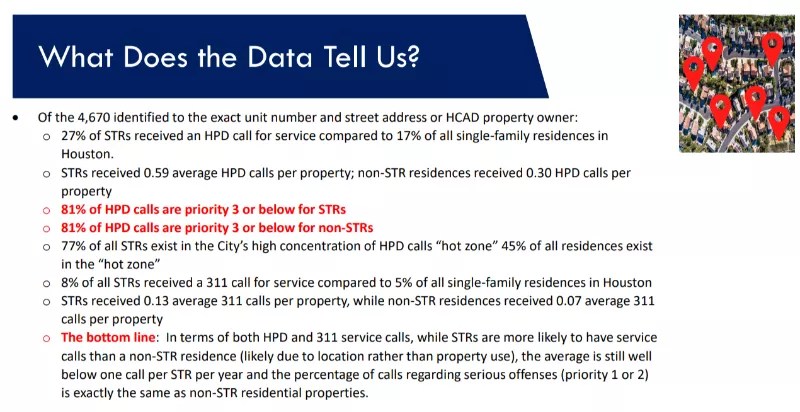
“Most people aren’t coming for parties,” Neundorf said. “Really it is less than 2 percent or 1 percent. Airbnb has already done a good job … All it takes is a couple of neighbors to complain and they get commonality and Airbnb shuts down the listing. Airbnb has taken care of most of the bad actors.”
Neundorf suggested that Houston could raise its hotel occupancy tax from 7 percent to 9 percent to better align with other large municipalities. The Texas Supreme Court has ruled that an Airbnb is not a commercial use, therefore there’s no legal standing if a homeowners association attempts to sue, he said.
But will the short-term rental owners and operators file suit? It’s a possibility. A group of businesspeople who asked to not be “the focal point” of this story is working alongside the Dallas Short-Term Rental Alliance, which was granted an injunction in 2023 after neighborhood short-term rentals were banned by the Dallas City Council. That matter remains in litigation but short-term rental operators are allowed to host in neighborhoods while it’s in the courts.
Neundorf said good hosts support permitting (although he thinks Houston’s proposed fees are too high) and noise-monitoring machines. Many hosts monitor cameras and send their own private security to evict guests when they become aware of excessive noise or nuisance activity.
“It’s more important that we’re a great neighbor than a good host,” he said.
Long said city leaders like Councilman Ramirez and officials with the Administration and Regulatory Affairs Department have sought feedback from operators and he’s tried to provide reasonable suggestions.
“We’re looking for consistency with other city ordinances such as the hotel ordinance or the apartment ordinance,” he said. “They’re going to pass something because they’re sort of invested in the process now. Our hope is that they’re going to pass something that’s sensible.”

This article appears in Jan 1 – Dec 31, 2025.
