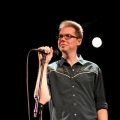
Bruce Springsteen’s team must have known early on that his concert in the Summit on December 8, 1978 was special. It was late in the more than 100 shows of his tour supporting his fourth album, Darkness On the Edge of Town, released that June, and momentum was building; Springsteen and his E Street Band had already sold out the 9,200-seat Sam Houston Coliseum in July.
That night, a Friday, turned out to be the second-largest crowd of the tour; its 12,003 tickets sold trailed only the Forum in Inglewood, California, by roughly 700 seats. What made this particular show appealing, technologically, was the closed-circuit camera system and giant video screens in the arena, a relatively new development in the mid-‘70s. The Summit had opened in late 1975, and live footage of other artists at the venue, among them Queen, The Who, and Prince, would eventually make its way to the black market. So too with Springsteen, through slightly more official channels.
“It is a true bootleg in that sense. We had a variety of shows that we were considering releasing from the Darkness tour,” Springsteen manager Jon Landau told Rolling Stone in November 2010, upon the release of the expanded version of Darkness known as The Promise; a DVD of the full Summit show was included as one of the six discs. “Some had good sound, but the picture wasn’t so good. Some the picture was good and the sound was primitive.
“Considering the various options, the Houston show worked on the most levels,” Landau adds. “The sound is raw, but good in deliverance. The picture has been enhanced as much as modern technology allows. It’s an extremely powerful show.”
Listed in the December 1978 issue of Texas Monthly as a “decadent Big Apple performer a la Dylan,” Springsteen, who was 29 at the time, and his E Street Band were flush with rock-and-roll virility. Biographer Dave Marsh would later rank the Darkness tour alongside Bob Dylan and The Band in 1966, The Who in ’69, and the Rolling Stones in ’69 and ’72 as “benchmarks of an era.” In Houston, they would prove as much all night.

With just four albums to their name at that point, Springsteen and company cover an admirable amount of territory. There’s a very Van Morrison “Spirit In the Night” and “It’s Hard to Be a Saint In the City” — which salutes “all the folks from the Liberty Hall days,” site of Springsteen’s first Houston appearance — from debut Greetings From Asbury Park, New Jersey, through a wide swatch of 1975 breakthrough Born to Run and Darkness, and even four songs that would wind up on his next album, 1980’s The River. As documented by The Promise, Springsteen and band cut dozens of songs for an album that was eventually narrowed down to ten; two that didn’t make the final cut, “Fire” and “Because the Night,” shortly became hits for the Pointer Sisters and Patti Smith, respectively. They’re in the Houston set list too, as is Clemons’ turn as jolly old St. Nick on “Santa Claus Is Coming to Town,” now one of rock’s perennial Yuletide standards.
Two hefty sets and a 25-minute encore, the show clocks in just shy of three hours. Egged on by their leader, with tenor saxophonist Clarence Clemons (aka “The Big Man,” R.I.P.) acting as a perfect foil, Springsteen and company are in total command. “Prove It All Night,” “She’s the One” and “Rosalita (“Come Out Tonight”), which opens the encore, stretch to almost 12 minutes. “Racing In the Street,” “Point Blank,” “Because the Night” and “The Fever” all pull up just short of nine, alternating serpentine instrumental passages with Springsteen’s amped-up backstreet serenades. On average, the shorter songs — “Badlands,” “Candy’s Room,” “The Promised Land” — are played so ferociously it’s almost like the band is trying to compensate for such brevity with extra intensity.
The crowd responds in kind. At one point Springsteen labels the boisterous Friday-night environment as “combat conditions,” and informs the audience “if anybody came here to throw firecrackers or bottles, you can get the fuck out, OK?” after a nearly 11-minute “Jungleland” closes the first set. The whole show ends with covers, three consecutive rock and roll forefathers who each imparted a good bit of their go-for-broke attitude into Springsteen: a nine-minute medley of tunes by Mitch Ryder & the Detroit Wheels (“Devil In a Blue Dress,” “Good Golly Miss Molly,” “See See Rider,” “Jenny Take a Ride”), the Dovells’ “You Can’t Sit Down” and Gary “U.S.” Bonds’ “Quarter to Three.” The author was ten days shy of his fourth birthday that night, but late Houston Post pop-music critic Bob Claypool was there; his review describes a performance that approaches complete delirium.
ZAP! He ran from one end of the stage to the other like a manic little rooster, now doing a long slide on his knees while wailing on guitar, now diving out in the crowd to stalk the aisle with Clarence Clemons honking saxophone behind him, now jumping on top of a bank of amps and then taking the great leap off, now resting quiet, yet coiled, in front of the mike for a low sotto voce endearment and, always, always, giving his all — a heart on fire with rock and roll.
Springsteen, now 68 and about to embark on a four-month Broadway residency, stoked the embers of that fire last week by releasing the audio recording of his Summit show as a fundraiser for the hurricane-relief fund of MusiCares, the Grammy organization’s charitable foundation that provides financial support and other services to musicians in need. The set is available through brucespringsteen.net in a half-dozen formats, from $10 to $40; physical CDs will ship October 9. It may have happened nearly 40 years ago, but this three-hour passion play of late-‘70s rock theatrics still has some pretty salient lessons for a city still nursing its wounds from the most devastating natural disaster in its history: don’t be afraid to roll up your sleeves and get dirty, we’re all in this together, sometimes nothing feels better than a good scream — and, for God’s sakes, don’t ever, ever quit.
Special thanks to Brucebase and thelightindarkness.com for additional research, and Bruce Kessler of rockinhouston.com for the amazing photos.
This article appears in Sep 28 – Oct 4, 2017.