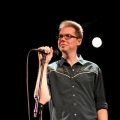
Ruben Jimenez got addicted to the hustle early on. Tonight his new label, Roologic Records, will throw a launch party at House of Blues’ Bronze Peacock Room that is already close to selling out. (See Cactus Music or this link for available tickets.) Performing will be a half-dozen of Houston’s flyest acts, all of them hand-picked by Jimenez for the label: MCs Genesis Blu, Kyle Hubbard and Brew (formerly of Lower Life Form); veteran R-rated rap duo Dirty & Nasty; psychedelic hard rockers Space Villains*; and Def Perception, the live hip-hop group where Jimenez works the turntables as DJ Baby Roo.
Jimenez has been working up to this night for more than half of his life, which is how long he’s been a DJ and promoter in Houston. He has a deal in place with Symphonic Distribution, a Tampa-based firm that offers both digital and physical distribution, mastering, licensing and other services; Jimenez sees Symphonic as a safeguard against his artists having to, in his words, “just create a Bandcamp and put [their] shit out and then have no one listen to it.” He wants Roologic to be more of a brand than a record label, incorporating visual art and comedy into its aesthetic while offering artists and customers alike “quality in presentation, quality in rollout.” He’s thought this through.
“You know, drop a single, let it bubble, make a video, let that bubble, then drop your album,” Jimenez says. “But while you’re doing that, doing shows. Be consistent. Put some order to it, like the big boys have done for decades. Why can’t local acts do that? It’s the same thing.”
Jimenez, fortyish, grew up on Houston’s near northside and says he fell in love with hip-hop before it was barely even called that, 1980-’82, when people would spit rhymes over disco breaks; “which we’re now calling electro beats.” He couldn’t dance, but wouldn’t hesitate to harass the DJs at house parties he went to if he thought the music they were playing was wack. Soon enough he would take over when they wanted a break, and from there it was a short hop to KPFT, where his brother helped DJ on a show called Guerrilla Scripts that aired from 2 to 5 a.m. on Tuesdays. On-air mixing followed, along with a front-row seat at some of the city’s first regular hip-hop listening parties like the weekly Hip-Hop Coffee Shop.
“I think it was, gosh, of course Tribe, and Public Enemy still, and then some of the local acts,” Jimenez recalls. “We had Johnny Quest, we had at the time the earliest version of K-Otix, See the Soul. Lots of young, burgeoning groups at the time that didn’t have a place to go. We were all there at that moment. Odd Squad came through with their record, and I’m 16 years old working the door, smoking weed and collecting three bucks.”
Jimenez also hustled money from record companies by putting up posters at record stores, accompanying acts like Gravediggaz on regional tours, and “working” certain singles the labels wanted to push, which meant calling a list of college-radio DJs and imploring them to spin the record. A gig at the old pirate station Montrose Radio allowed him to start reporting to certain trade journals, which kept the records flowing. A lot of them were crap, he says, but he also worked Slum Village, Gang Starr and Big L. Flying off to spin at music-industry gatherings on the weekends, Jimenez says he did well enough to buy a four-bedroom house with a two-car garage. But after 9/11, everything ground to a halt.
“Sales were dipping, budgets were being cut, so all my independent record-promo money was gone,” Jimenez says. “And my connections were pretty much gone in a month, because they fired a bunch of people from the industry bleeding out.”
With two kids to support, during all this time Jimenez was also working at places like the Enron mail room and various law firms; today he’s the technical services manager (IT) at one of the city’s biggest, Norton Rose Fulbright. But when his kids started to get a little older — they’re almost 18 and 20 now, he says — Jimenez started to DJ more. When he did, it didn’t take long for him to realize the scene he was walking into was pretty chaotic.
“You’d go into a place and there’d be 18 openers, and then the crowd would be exhausted by the end of the night before the main act came on,” Jimenez says. “Promoters were creating these bad situations where acts — we can call them acts, but these people had never touched the stage before in their lives — would bore the living shit out of everybody for four hours damn near, three and a half hours, before a main act came on.”
Not every show he went to was awful, he admits; pointing to the Waxaholics, Soul One, Soul Control, and Gracie Chavez and Bombon as examples of what he’d like Roologic’s events to be: nights that consistently deliver quality music. Furthermore, that sense of being part of a team, of belonging to an organization with its artists’ best interest at heart, is essential to Jimenez’s business plan. One condition of Roologic membership is that his artists not only promote themselves, they promote the entire roster.
“That not only shows unification, it shows that you can actually believe in someone else and it benefit you as well,” Jimenez says. “Why I chose to work with these folks is they were willing to do something like that. It didn’t scare them. They actually like that idea.”
Roologic’s launch party sets up shop tonight at House of Blues’ Bronze Peacock Room, 1204 Caroline. Doors open at 8 p.m.

Related Stories

This article appears in Mar 10-16, 2016.