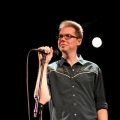
Who does Muse think they are?
Big Rock Stars, with a Big Stage Set to go along with their Big Ideas. A Big Stage Set that can, apparently, only be photographed from 100 yards away – any closer and the British trio’s synapse-taxing lasers and jackbooted rock might have fractured a lens or something.
But the biggest thing of all about Muse is the melodies, which bolt the sweeping ache and melancholy majesty of a Tchaikovsky symphony or Rachmaninoff concerto (Aftermath likes the Russians; so does this band) to girders of hard-rock fortitude. For a band that nine times out of ten gets labeled “progressive,” it’s remarkably simple. And deadly effective.
Muse opened with “Uprising,” which began against a backdrop of silhouetted figures climbing staircases on the stage towers, some falling off, as synthesizer squiggles gradually resolved into the bounding bass line and jolting power chords that staged a coup on U.S. radio last fall and allowed the longtime stadium rockers in their homeland to finally graduate to American sports arenas. (Toyota Center was about three-quarter full – the lower bowl almost totally, the middle section maybe half, and the top tier not so much.)
Right-wing ranter Glenn Beck tried to appropriate this anthem of
individuality vs. official oppression to no small degree of
consternation from the band shortly after it was released last year,
but he wouldn’t have liked the way it was presented Thursday at all –
the crimson LED lights, front man Matt Bellamy’s Venetian-blind glasses
and crowd shots gave off a “Power to the People” vibe like a
Red Army recruiting drive at Ridgemont High. When the light filtered
through at a certain angle, the three band members appeared to be
standing on top of cages. Symbolic?
Next came “Resistance,” a haunting love song based on George Orwell’s 1984 (“you’ll wake the thought police”) that set the teasing piano melody
and Bellamy’s yearning vocals – sorry, but he really does sound a lot
like Thom Yorke, even if his band sounds nothing at all like Radiohead
– against a display of DNA double helixes and a Matrix-like
data feed that posed the question “How much is music hard-wired into
people’s genetic makeup?” And, maybe more importantly, “How many bands
can even make people ask that?” Muse didn’t really need those visuals
to do that… but they helped.
“New Born,” from 2001’s Origin of Symmetry, emerged in lively, Bach-like keyboards, the cages lowering
almost to the level of the fans. (Symbolic?) A barrage of green lasers
was expertly timed to the band’s furious, metallic onslaught – which
completely drowned out the lyrics, but it’s another one about the
soul’s struggle for survival in an inhospitable world – while the
robotic sound effects that reminded Aftermath of all the time we’ve
spent playing Mass Effect lately.
Alas, since Muse’s show relies so heavily on visual effects, and
photographers were only allowed to shoot the first three songs,
Aftermath thought it only fair that we cut off our review at the same
interval. To be continued tonight at SXSW…
This article appears in Mar 18-24, 2010.