

The most important speech of 1996 was not delivered at a political convention. It was not delivered by a public figure; rather, it was a fictional public figure. It was Bill Pullman, as President Thomas Whitmore in Independence Day, who delivered the rallying cry of my childhood. Surrounded by impossible odds, a destroyed White House and looking in the face of Will Smith among others, Whitmore had to rally not just the troops but the world itself. The most important line of his speech comes around the middle; it’s centered around a state of being: “We are fighting for our right to live, to exist.”
The second most important speech of 1996 came below the Mason-Dixon line. It was not from a Hollywood set, but came from a man who probably inspired just as many troops as Whitmore did. This man broached a topic that felt as right for him as it did the rest of the world: respect. It was delivered with fury; measured anger and a calculated drawl. While President Whitmore had the urging of Americana backing his words and diction, this speech had funky guitar loops born from spaghetti westerns, New Orleans’ bounce whistles and snare drums.
“Well it’s Pimp C bitch, so what the fuck is up?”
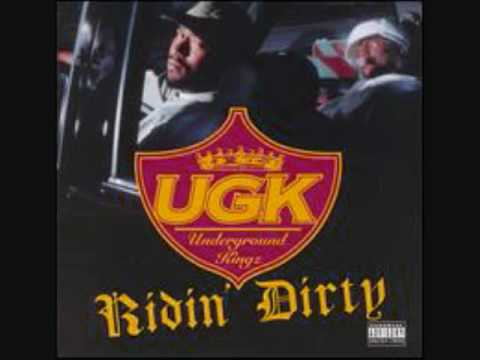
In rap terms, UGK’s Ridin’ Dirty was all about fighting for the right to exist, for which there was no louder moment than Pimp C and Bun B’s opening refrain from “Murder,” There is no chorus, just pure rapping from Chad Butler and Bernard Freeman. They ran their seminal third album like a presidential campaign; only both of them could have traded between President and Vice President on any given day. At different times, Ridin’ Dirty can be somber, being honest, being funky and the perfect soundtrack to a blaxploitation film.
It may not be the greatest rap album the South has ever produced, but it’s one of them. It is, however, the greatest album UGK ever produced, the perfect meeting point of Pimp C’s creativity and Bun B’s increased presence as a dominant MC. It’s a pioneering record for a number of reasons: one of the first to use ProTools, the first national mention of drank (ESG’s mention on “Swang & Bang” was far more of a regional milieu in ’95), candy paint and other bits of Houston car culture, and more.
Pimp is far more beloved because of his sheer presence and personality; Bun for delivering the most unforgiving rap verse the South ever produced and being a proud elder statesmen, professor and occasional political-party convention attendee. Ridin’ Dirty saw Pimp and Bun as equals, unique geniuses who did what made them great better than what others did to make them great. And it meant something to both.
Much of Pimp C’s production was tied to conviction and belief. He believed that Willie Hutch meant as much to Southern producers as James Brown did to Marley Marl and others. That the sounds of Stax, Hutch, Chaka Khan and Wes Montgomery had a say in the boom-bap that dominated the sample-based records out of New York or Los Angeles. To him, those records were the basis for country rap tunes, Southern-fried production tied together by life experiences and bloated egos. If it felt like the ‘70s to Pimp and could be soundtracked to The Mack, it fit into his thinking in regards to making a beat.
DJ Premier, despite being born in Houston and educated at Prairie View A&M, is central to New York-style production, which ultimately became synonymous with an entire region. Cut-up vocal samples became his trademark. Dr. Dre merged the sounds of New Jersey-born Parliament-Funkadelic and stylized West Coast funk to create G-Funk, funk’s far more brooding stepchild with heavier drums. This is central to the creation of Ridin’ Dirty, because the sound of hip-hop in 1996 was morphing and expanding. Car culture had been attributed to the growth of hip-hop in Los Angeles and especially in the South. If the drums were tweaked just enough and the synths sparkled then it became part of the riding experience. “I made this for the niggas tryin’ ta chop in they cars,” Pimp would say years later on “Choppin’ Blades.” It was all he wanted his music to do — to travel around the world and to be understood.
By 1995 and going into 1996, Pimp felt dissatisfied with the industry as a whole. The moment Andre 3000 made it clear “The South Got Sumthin’ to Say” at the 1995 Source Awards, the seeds were planted for every other rapper from the South to follow suit. UGK had already created the blueprint for dopeboys who never aspired to mafioso status; humanizing the need to sell for the sake of daily survival. However, it didn’t register the same way it should have across the country. Two rappers from the oil town of Port Arthur were looked at and shrugged off. Jive Records had switched A&Rs and pushed Bun and Chad to work in Jive’s Battery Studios in Chicago with live instrumentation; UGK’s manager, Mama Wes, ultimately told them the records they made in Chicago were “boo boo.” “The worst shit I heard in my life,” she told Julia Beverly in Sweet Jones: Pimp C’s Trill Life Story. It was certain that everything had to be done at home, regardless if Jive Records started treating them like important regional rap stars.
Here’s the constant about home— it brings out the best and worst in you. It’s a comfort zone, an embryo that not only nurtures you it can also take away from you. Home is also where you hear stories about the best of your friends and the worst of them. The stories of home, the internal struggle in regards to relationships and friends became the opening sonnet of “One Day,” a song I used to revile as a child because of what it meant to people.
As a kid, I hated funerals. I still loathe them to this day, as my body won’t allow me to emotionally release. So whenever I snuck a copy of my uncle’s UGK cassette, I couldn’t wait to get past the end of “One Day.” It didn’t matter if I knew that Ronnie Spencer was doing the greatest imitation Ronald Isley he possibly could. Or that Chad and producer N.O. Joe had smartly tied the Isley’s “Ain’t I Been Good to You?”, a song about the loss of requited love. Mr. 3-2, the former Rap-A-Lot stalwart and a man Bun B credits for improving his rapping throughout Ridin’ Dirty, batted leadoff and it feels like the world is about to collapse on itself when Bun reminisces about friends from Short, Texas dead over the most trivial of things. He’s scrapping the well of paranoia so far that he thinks going to jail after his brother is released will be a reality. And Chad God is the anchor leg of “One Day,” such a devastating reminder of life’s fragility. He’s clutching AK-47 magazine loaders and questioning God why bad things happen to good people. The December 1995 house fire that claimed the life of Bo Bo Luchiano’s son is the final testament of how incredibly powerful yet fucked up “One Day” is. To have it segue into a bout of realized anger is mesmerizing.
Some levity is brought on by “Pinky Ring,” a guitar-tweaked discussion of pimp life and living with the inflated sense of being a player. It’s the album’s first mention of Houston car culture, which UGK had steeped themselves in once they began hanging at DJ Screw’s house. No one had discussed elbows, ‘84s’ and candy paint on a national rap album before Ridin’ Dirty. Screw’s 3 In Tha Mornin’ Pt. 2 had come out earlier in 1996, but Big Tyme Records’ distribution was dwarfed by Jive’s. To some, the first mention of the word “slab” came from UGK. It was on purpose.

Ridin’ Dirty, considering its slow nature and musicianship (thanks to mostly Pimp and N.O. Joe), is the most refined Screw tape that exists. There are car records, there are records that detail the reality of being a rap star but just a regular person to your family members. Much like how dipped cigarettes played a role in the creation of 1994’s Super Tight, British Columbia weed and codeine played a role in Ridin’ Dirty. On “3 In The Mornin’,” an easy homage to Screw himself, C-Note of the Botany Boyz told the world UGK was “comin’ dine.” Pimp C mentions $5 for a sack of weed and $50 for some drank on the song’s chorus. Twenty years later, the syrup is far more expensive, but none of what UGK was rapping about then should be considered new now. The best example of this? The song following “3 In The Mornin,’” “Touched,” sees Bun running with the familiar stanza “now once upon a time not long ago” that Jay Z borrowed some seven years later for “99 Problems.” Jay’s initial UGK fandom came via Ridin’ Dirty, which in part led to the existence of “Big Pimpin’” in 1999.
The fascination behind Ridin’ Dirty in my adulthood can be pinpointed by two things: Bun’s verse on “Murder” and all of “Diamonds & Wood.” The former is a callback to the past, classic form of recording raps. It was the very thing that northern rap fans and critics had derided about the South, that whatever they were doing was hip-hop and what Bun, Pimp, Goodie Mob, et al. wasn’t. For someone who grew up on Chuck D and Public Enemy among a litany of East Coast rap groups, Bun had something to prove. Not just to Mr. 3-2, who had been his sparring partner in freestyle sessions leading up to the album, but the world at large.
“It was that demanding,” Bun said of the verse. “After I did that record, I went to sleep.”
In a February 2016 interview with Complex, Bun detailed why it was important for him to steer clear of using ProTools, then a new player in punching in vocals on tracks to get the verse perfectly right. “I literally took the hardest way possible to do that verse,” he said. “With the most updated technology at that time.”
He continued, “They were trying to push upon me the ability to punch in. And I had just written “Murder.” That was about to be my greatest lyrical example, my greatest performance on record. And I was like “I don’t give a fuck if you have the ability to punch in and shit, I’m gonna do this with breath control, not eight bars and punch in.”
The “Murder” verse is breathtaking because it’s a one-take, straight zoom through proving points and taking names all at once. It starts off with Bun in a moderate timbre and just escalates further and further. It doesn’t end until he delivers the 1996 version of “Have a Coke and a smile and shut up” and steps away from the booth. N.O. Joe witnessed it and marveled. In conversations with him two years ago surrounding Scarface’s The Diary, he still couldn’t believe Bun did that with zero pauses.
“Diamonds & Wood,” which is the perfect UGK record, is mostly a song about Pimp C realizing the relationship with the mother of his child is strained beyond belief. “All we do now is fuck and fight” is a common place in relationships, when getting along is only tied to sex and arguments. The unhealthy nature of it is beyond the point but in a micro-discussion, it’s a big damn deal in the world of UGK. The record pits together two staples, one of Chad’s production loves in Bootsy Collins “Munchies For Your Love” and a record known to Houstonians via Screw: .380’s “Elbows & Swang.” Smoke D’s husky voice operates as a middle finger to the conscience of home, adding to the ethos professed on “One Day” and Pimp rides with it. It’s a form of the blues and in plenty of cases, Pimp C was a teller of the blues. Bun could admit to not being the best weed roller, and you believed him because none of your blunts were perfect. Nor should they have been. Despite being hardened men who sold cocaine in the back of the ride, UGK was human, capable of fault and misdirection.
It still stands as Pimp C’s favorite UGK record, ever.
In February of this year, a crowd gathered inside of Warehouse Live to mourn. I was among them. Bun B stood on the stage, the lights down and a DJ booth behind him. People were audibly crying, holding lighters below him. “It’s OK to cry, y’all,” he told us.
This was about Morrow Potts, a man we knew as L.A., one of the venue’s stage managers and talent coordinators. L.A. died of a heart attack at only 38 and the entire music scene stopped to pay respects to him. After the memorial ended, the DJ behind Bun began to play “One Day.”
That’s when the tears began. Audibly. “One Day” serves as the first lesson taught about Ridin’ Dirty. Smoke D’s interludes from jail were supposed to be the comic relief, even if they were just as bleak was the second. “Murder” was the one-take rap masterpiece that exhausted Bun himself, the third lesson. “Diamonds & Wood” perfectly encapsulates everything UGK meant to people; a record about driving away from drama from two superheroes who were just grown men adjusting to new situations. The underrated “Hi-Life” packed next to “Ridin’ Dirty” were the last actual rap moments, the fifth and sixth lessons of their perfection. And how did the album end?
With Pimp, celebratory and jubilant at what he and Bun had accomplished.
This article appears in Aug 4-10, 2016.
