Theater is in a rather interesting space right now with hip-hop. A musical based upon the life of Alexander Hamilton, Hamilton, is currently the hottest show on Broadway. Classic hip-hop has replaced dad-rock as the go-to radio choice for adults born in the ‘70s. It’s a unique twist on the exploration of hip-hop — past, present and future.
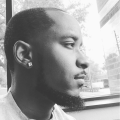
Baltimore playwright NSangou Njikam is bringing his own hip-hop upbringing to Houston’s Alley Theatre this weekend. Syncing Ink, presented as part of the Alley’s Alley All New Festival, is a semi-autobiographical journey of Njikam’s life, bridging his upbringing and his love and passion for rhyme. And he’s genuinely proud of it. After tracing his roots back to the African country of Cameroon, Njikam explored even further, recalling certain life events to help bring Syncing Ink to life.
Njikam is a lover of the golden age of hip-hop, citing Rakim’s “Don’t Sweat the Technique” and A Tribe Called Quest’s “Electric Relaxation” among his favorite records. We joke about the time I went to a Rakim show and got a New York Mets hat autographed, the varying degrees of being black and how America’s currently having a crisis over Cam Newton and his variance of black. The sentiment is there. Njikam is a child of hip-hop, right down to understanding how the new class can still teach the older generation new things and new twists.
“I definitely don’t feel any nervousness at the moment,” he says over the phone a few days ahead of Saturday’s first live reading of Syncing Ink. “I’m getting acclimated to Houston for the first time, getting used to the Alley Theatre for the first time. And everything’s big. I see where I am; now I’m about to show you who I am.”
Houston Press: How did growing up in Baltimore shape Syncing Ink?
NSangou Njikam: I grew up in the suburbs at a time when the things that were popular were The Cosby Show and A Different World, Thundercats and He-Man and hip-hop. Every generation has those burgeoning musical styles or genres, and what was burgeoning at the time was Run-DMC and Rob Base & DJ EZ-Rock and Salt-N-Pepa. Those were the things I was hearing. Even my Boy Scout troop knew the lyrics to “It Takes Two.” That was the sound we heard as kids. The Isleys and The Spinners were the connective tissue for my parents. For my friends, it was Kurtis Blow and Afrika Bambaataa.
Was there any particular point in your childhood that you chose to leave in for the play?
I think every kid who listened to hip-hop tried to rap after the album went off. The way, when Diana Ross was out, everybody tried to sing. Or how a Michael Jackson video went off, you tried to do the dances. So it was something where you recognized power. [Syncing Ink] isn’t about me as a little kid, but more about my high school and college days. And hip-hop was something I thought I couldn’t do. You watch Yo! MTV Raps and BET, The Box, and it was something I thought I couldn’t do but it seemed fun. But it wasn’t until I started putting rhyme schemes together that I thought, “I could do this.” By the time I got into college, I wasn’t just an actor. I was an actor entering into a burgeoning world called hip-hop theater.
Do you think there’s going to be a growth with hip-hop theater as time progresses?
You know, that’s a good question in terms of will you see more. I think there’s a sense, with Hamilton in particular, that hip-hop theater is easily understood now, as opposed to what Danny Hoch and Camilia Ford were doing in the 2000s. It’s not fringe, but yet it’s still so new. It’s not something that’s taught in institutions that teach theater at a professional level. So, either you can do it or you can’t. They do seminars and master classes, but it’s something you have to be immersed in. The growing demand for it from audiences will add to that growth, I think.
Have you met your cast already — do they nerve you out?
No, they’re really, really great [Laughs]. I don’t even call them actors; they’re more like grios. They transform and shape-shift and invoke ancestrally various spirits. There’s qualities of the black church, qualities of “Throw your hands in the air and wave them like you just don’t care!” Fortunately, I have a cast that can do that. This isn’t a play where you come in, watch it and bounce. It’s a play where you’ll feel like you were in the midst of a cypher. So they know what time it is! [Laughs]
You transitioned from growing up in Baltimore to writing plays for Penn State. I know there’s a cliché behind breaking barriers, but there’s a weight to it.
Right, right. Steve Broadnax, the brother who’s the head of the MFA Acting Program there, [is] big on bringing in new voices, all voices, diversity. Not just bringing in African-American playwrights, but more bringing in voices who are speaking to the now and the future. Going into Penn State, yeah, you understand the context of what you’re stepping into. Because this isn’t the accepted mode or conventional way of presenting a play. That being said, in an institution of higher learning, you have to understand how theater is shifting. For example, of the top-grossing playwrights in the country, Dominique Morisseau has like 12 plays running, across the country. And she just won the Steinberg Award and the Kennedy Prize and people are doing monologues from her plays to get into college.
Like “Detroit ’67″…
Right. And cats who came into auditions, either they were really good actors or they were really good MCs. And few could merge the two. So how are we pushing theater forward? I don’t knock the past, but there’s past, present and future. I’m not going in thinking, ‘I’m going to break a barrier.’ I’m thinking, this is my truth, this is my speech and this is how I do it. So going back to doing Shakespeare? That should be a cakewalk compared to what I do. So, I’m not afraid of Penn State. [Laughs]
It shocks me that the diversity in theater, compared to other industries, is like night and day. So when people call Syncing Ink a hip-hop play, it gets different looks from saying it’s a coming-of-age play.
I’m proud of hip-hop. So when I use it, I use it and anything that’s related to something of the African Diaspora as a symbol of pride. I do that because when the conversation of diversity comes up, they talk about it like it’s rocket science. For example, there’s a huge Spanish-speaking community in Houston. How many plays are being written about that? So when people talk about diversity, they always make it seem like a big ‘How do you do that?’ To me, the answer is, ‘You program the shows.’ It’s not complicated! The secondary question is, will the dominant audience see a show that isn’t about them? Or they don’t have an access code to? At the end of the day, theater exists around the world, whether it looks like Western theater or not. All you need are performers and a space. Whatever that is inside of that, you put in. You can reflect diversity in your programming and still have great theater. Even if that requires theater stretches the definition of a play beyond what it currently is.
What I’m doing may seem pioneering or groundbreaking. But people were doing this for a decade before I was. It was a decade of me learning how to do this before I actually did Syncing Ink. As an artist, I have to stand in my power and pride. I told the story from this vantage point, from these styles because I come from these people. There’s no problem with that because we don’t check off that. Before we even get to diversity, let’s just get to us as a people. There’s a diaspora that exists through the shared internal experiences of the continent of Africa and all of its 54 current present-day nations. Languages, cultures, dialects, traditions that manifest to this very moment. Even the way I conduct myself in the theater is informed by my lineage. Our own diversity? That’s worth exploring.
So that’s what Syncing Ink means to you?
It’s one representation of it. Like August Wilson said, “The specific leads to the universal.” So if we follow that mantra, we’ll explore that diversity as a necessity. To the effect of, I don’t know me until I look at you again. I don’t know more of who I am until I explore everything in my experience. So if we want to grow, we’ve got to foster new audiences and program new shows. It won’t be the last but hopefully it’ll inspire. And I’m looking forward to the kids performance and fostering the whole idea that there’s gonna be a kid who says they cay do it better than me. I’ll be ready for them, though! [Laughs] Theater used to be about learning this one way of doing it. Now that one way is being forced to learn about other ways. It doesn’t change overnight.
Performance workshops of Syncing Ink will take place at the Alley Theatre, 615 Texas, the following dates and times as part of the Alley Theatre’s All New Festival: 11 a.m. Saturday, January 30; 10 a.m. Thursday, February 4; 8 p.m. Friday, February 5; 3 p.m. Sunday, February 7.
This article appears in Jan 28 – Feb 3, 2016.