Jenny Boyd wasn’t just a chronicler or observer of the ‘60s and ‘70s rock and roll scenes in the US and UK—she was an active participant.
The It Girl model inspired Donovan’s “Jennifer Juniper,” was married to Mick Fleetwood (twice) with whom she had two children, and had a front seat to the soap opera that was Rumours. This also made her something of a rock and roll Zelig, appearing in recording studios, backstage dressing rooms, and house parties, crossing path with a wide variety of musicians.
And she accompanied her sister and brother-in-law to Rishikesh, India, when the Beatles made their 1968 spiritual pilgrimage there. It’s of no small note that her sister, Pattie Boyd, was married to George Harrison, then later his best friend Eric Clapton.
Jenny Boyd was (and is) at heart both a writer and a seeker, wanting to know more about the background and creative/spiritual forces that helped create art rather than just the art itself.
So, in preparation to earn a PhD in Humanities, she began to interview some of her famous musician friends about their background, touching on the spirit of songwriting, creativity, imagination, and even if drugs and alcohol helped or hindered their process (Boyd later worked in an addiction treatment center).
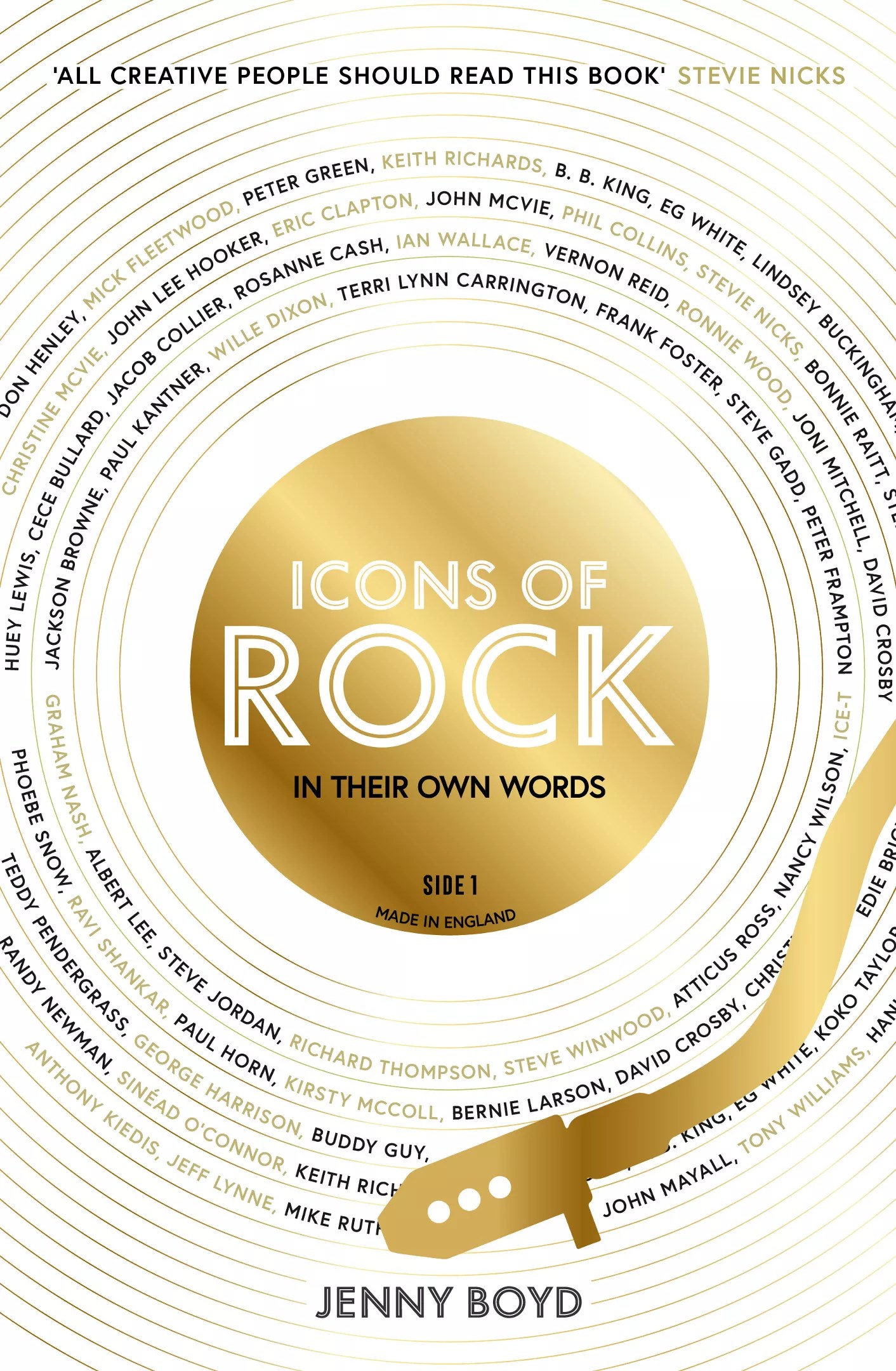
More than 60 of those talks are included in her anthology Icons of Rock: In Their Own Words (432 pp., $42.99, Mango Publishing). It’s an updated, expanded and rejiggered edition from her original 1992 book, Musicians in Tune. Most of the interviews took place between 1988-1990.
Boyd’s list of subjects grew and grew to include A-list Rock and Roll Hall of Famers too numerous to list here, cult favorites, studio musicians, and country, blues, R&B, ‘80s rock, and even rap superstars. Naturally, members of the Beatles, Fleetwood Mac, Crosby, Stills & Nash, and other members of the Laurel Canyon Singer/Songwriter Mafia are well represented.
After carrying around her precious cassette interview tapes for years, Boyd decided to destroy most of them, saving only eight whose interviews are reproduced here in full for the first time (Joni Mitchell, George Harrison, Eric Clapton, Ringo Starr, Graham Nash, Ravi Shankar, Don Henley, and drummer Tony Wallace). She adds handful of new interviews with UK musicians (likely unfamiliar to U.S. audiences). Boyd’s reflections, and additional quotes from her subjects fill out the new text, with each interview running between two to 16 pages.
There is plenty of biographical information, especially about the subjects’ formative years. Don Henley talks about his failures as 98-pound, 15-year-old helplessly overwhelmed on the Lone Star State football field. “To play football. That was the heroic, natural thing for a [Texan] male to do,” he offers. But Boyd is more interested in plumbing deeper topics of art, creativity, spirituality, and muse.
Peter Gabriel calls accepting the creative muse akin to quivering like a radio aerial. Stevie Nicks is frenetic going from paper to piano to art to poetry, dreams, crystal visions and back again. The Jefferson Airplane/Starship’s Paul Kanter discusses his generation’s “real problem with moderation” of drugs as a creative and recreational substance.
Rolling Stone guitarist Ronnie Wood—an accomplished visual artist—remembers forcing a very reluctant Mick Jagger to create his own drawing. He called it “fantastic,” indicating that creativity doesn’t have to be limited to one box (skill, though, is another thing). The reliably mystic George Harrison offers “The divine creativity is the creative intelligence of the universe because it is within our soul.” And Bonnie Raitt is frank about how drugs and booze helped her to become a completely different “Bonnie Raitt”—the “rock ‘n’ roll blues mama.”
The late Sinead O’Connor tells Boyd, somewhat prophetically given her life in recent decades, “I’m probably the only person around who communicates emotionally, who communications very start or turbulent emotions. My function is to get people to express themselves and get all that shit out. I express emotions about things that society doesn’t want to hear about—like miscarriages, abortions, rape or child abuse.”
That in 2024 those topics are far more prevalent in music and far less stigmatized speaks volumes about how far acceptance of “real life” on records has developed.
The book has plenty of fun tidbits about the artists as well. Joni Mitchell apparently got a kick out of (and took it as a personal challenge) to sweet talk police officers into giving her their badges. Michael McDonald’s first singing experience was when his father propped him up on a bar at the age of four to sing a sentimental song, possibly “Love is a Many Splendored Thing” (though he presumably did not have a beard or That Voice then). And the only way that Stephen Bishop’s rock and roll-hating stepfather would allow him to watch the Beatles on The Ed Sullivan Show was if he promised to clean the yard. Every day. For a year.
Readers looking for a more traditional Q&A/interview anthology book might find Icons of Rock a bit offbeat. But for those interested in deeper or more ethereal onion layers to musicians and their art, the collected wisdom and thoughts here are compelling and on another wavelength.
This article appears in Jan 1 – Dec 31, 2024.