Rachel is a buyer who purchases memories. Authenticity is prized and once a person’s memories are accessed and downloaded, the accounts are digitized and available for rent by the public. Now she’s after the memories of the last surviving Holocaust victim, Rivka, who happens to be her own grandmother.
Is this good that the Holocaust experience can now be intimately understood and remembered by future generations? An intrusion into someone’s private life? Paid-for voyeurism? A chance to keep something alive that should never be lost?
Or just a more modern version of oral traditions handed down generation to generation? With perhaps a higher level of accuracy to the stories.
Memoriam, by playwright Noga Flaishon and set in “the near future” is making its world premiere at Main Street Theater. It was developed by the Jewish Plays Project and introduced to Main Street through the Houston Jewish Playwriting Contest in collaboration with the Evelyn Rubenstein JCC.
One of several prompts for Flaishon thinking about who owns whose stories was Falsettos-gate in 2019, she says. Written by a U.S. composer, it has clearly Jewish characters, but in a production in London it did not have any Jews in the cast or on the creative team. “We had a whole thing about Falsettos-gate where a production of Falsettos was put on without a single Jewish creative. Everybody was really upset about this. Everybody was like ‘They just want our stories but they don’t really want us.’
“And that led to broader discussions about why are there so many Holocaust movies? Why has Holocaust movie become its own genre with its own stock characters and the beats that you have to hit in the story?
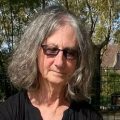
Flaishon who describes herself as neurodivergent and queer, “and a huge nerd” — she runs Dungeon and Dragons sessions, grew up in Israel and is now based in London. “I grew up as Jewish, obviously, but I didn’t think of myself as Jewish until I moved to the UK because being Jewish in Israel is kind of like the norm. Being a queer woman in Israel, a liberal queer woman, religion was mostly the face of the oppressor. So I didn’t think of myself as Jewish until I moved to the UK.”
Her play is centered around Passover “where we all sit down and talk about the big thing that has happened to us. Which made me realize how much story telling and the passing down of stories is such an inherent thing.
“It’s an inherent thing to every culture but Judaism just has the benefit of the fact that we’ve written it all down. And we were a displaced population for quite a big chunk of our history. so passing down stories became an element of a preserving of a people.”
Her mom and dad used to take her to children’s theater in Tel Aviv. When she was old enough she joined a drama class. Then she went to an arts high school. “The strength that theater has is its immediacy, and the immersion of it. You find yourself immersed in the story. You find yourself immersed in a story in a way you wouldn’t if you weren’t seeing real people in front of you doing that.”
Readily acknowledging that memories can be inaccurate, Flaishon says: “It’s a known fact that we never remember something the same way twice. We edit the memory as we grow and some people have a remarkable ability of rewriting their own memory which is scary.
“The interesting thing about traumatic memory is that traumatic memory is not remembered as a narrative but as a physical imprint in the body. If you experience a car crash the focus of the memory is less likely to be the moment that you got into your car and put on your seatbelt. What you are more likely to remember is the burn of the seat belt, the pressure or the smell. Those are the things that remain unchanged.”
Before the Pandemic she was an actor. In hindsight during the height of the Pandemic when she couldn’t get work as an actor she decided she was okay but not more than that. “It really forced me to sit down and do something else. I’ve always written stories and plays and scripts. During the Pandemic that became the main thing. And during that year and a half in lockdown I have written two and a half plays.” And some of that led to her involvement in Dr. Who audio drama.
The story is told through the point of view of Rachel, now a buyer for Memoriam. “She used to be a diver, a person whose job it is to go into people’s memories and test whether or not they can be made into digital content. And now she is in charge of acquiring these memories for the company,” Flaishon says.
Rachel is played by Julia Krohn and the grandmother Rivka is played by Chesley Ann Santoro, who happens to be Krohn’s mother in real life. Other cast members include Dillon DeWitt, Dain Geist and Sammi Sicinski. The play is directed by Julia Oppenheim.
Obviously the way Memoriam buys memories does not exist in our lives today, Flaishon says. “It’s sort of like an allegorical exploration of the film industry and our own social media engagement and the way we curate and narrativise our own life to an online audience.”
“I think people in our generation are very used to cannibalizing elements of our lives in order to generate an image of authenticity online.”
Performances are scheduled for March 29 through April 19 at 7:30 p.m. Thursdays through Saturdays and 3 p.m. Sundays at Main Street Theater – Rice Village, 2540 Times. For more information, call 713-524-6706 or visit mainstreettheater.com. $40-$63.