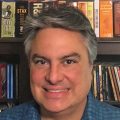
It’s the day after Sir Paul McCartney’s 81st birthday, and Joe Baiardi has more than a passing interest in the life and music of Macca. After all, the singer-bassist-guitarist has been “Paul McCartney” in the Beatles tribute band The Fab 5 since 2003, often seen slipping into that gray collarless jacket with a mop top wig or shiny blue Sgt. Pepper outfit. Though it’s not just Paul’s Past that entices him.
“He still puts on an amazing show. He looks great and he’s playing all the time. He’s going to keep doing it like Ringo. And Ringo’s two years older!” Baiardi—who last saw McCartney perform from the second row at Minute Maid Park in 2012—laughs.
“He’s also doing three and a half hour shows without even taking a drink of water. I don’t know how he does it! There was a rumor that he was taking these special lozenges, but who knows? I couldn’t do it. And he’s more than 20 years older than me!”
But the Houston-based—in existence since 1990—doesn’t just play Beatles music. At some shows the broaden their sonic palette to the wider British Invasion catalog, as they’ll do with a show on July 9 at the Main Street Crossing in Tomball.
The rest of the current lineup includes Paul Byron (keyboards), Chuck Essick (rhythm guitar), Danny Kristensen (lead guitar) and Rod Robert (drums). All also contribute vocals.
A typical set list will feature familiar tunes by the genre’s Mount Rushmore: Beatles, Stones, Kinks, Who. But the Houston Press wanted to dig a little deeper with five numbers that will likely make the show for Baiardi’s takes:
“The House of the Rising Sun” by the Animals, No. 1 in 1964.
The Animals wouldn’t be the first group to cover the song—some music scholars have traced the traditional English ballad’s melody and subject matter back to the 16th or 17th century. And they weren’t even the most prominent act to cover it. Bob Dylan put it on his 1961 debut record (copping the arrangement of fellow folkie Dave Van Ronk).
But the Animals’ version is the best known, buoyed by guitarist Hilton Valentine’s distinctive arpeggio guitar opening, Alan Price’s ethereal organ solo, and Eric Burdon’s vocal of warning and regret. It was reportedly recorded in one take, and the Animals were inducted into the Rock and Roll Hall of Fame in 1994.
“Great song. And we replicate it as close as we can to the original recording,” Baiardi offers. “But it’s difficult to sing! Eric Burdon really belts it out, sort of like Tom Jones. Both of them are such powerful singers.”
“Ferry Cross the Mersey” by Gerry and the Pacemakers, No. 6 in 1965.
While they achieved some success in the U.S., Gerry and the Pacemakers were a much bigger draw in the UK. It helped that they shared a city of origin (Liverpool), manager (Brian Epstein), and producer (George Martin) as another certain four lads. In fact, their first hit—”How Do You Do It?”—was originally earmarked for the Beatles, who didn’t care for the song and convinced Martin to let them release one of their originals instead as their first single, “Love Me Do.”
The title refers to the Mersey River in northwest England and the commuter/vacationer boats that travel (to this day) between the cities of Liverpool, Birkenhead, and Seacombe. It came from the band’s musical film of the same name.
“Another great Liverpool band, and recorded in studio 2 at Abbey Road. Gerry Marsden’s voice was just fantastic,” Baiardi says—thought he acknowledges the average American teenager might not be familiar with the titular body of water.
He also says that the band might have been bigger in the U.S. except that their records were initially issued on the smaller Laurie label here. Though they were still more successful than, say, fellow Liverpudlians The Big Three, Cilla Black or Billy J. Kramer and the Dakotas.
“To Love Somebody” by the Bee Gees, No. 17 in 1967
Many only know the Brothers Gibb as the hairy-chested, leonine, satin outfit wearing trio of the ‘70s disco era. But they also had a successful string of hits in the previous decade as a baroque/psychedelic group (with a regular guitarist and drummer) with “Massachusetts,” “I Started a Joke,” “New York Mining Disaster 1941,” “Lonely Days” and “I’ve Got to Get a Message to You.”
The soul-based tune was a particular favorite of Barry Gibb’s, and was reportedly written with Otis Redding in mind to sing as a cover version (Redding died in a plane crash later that year). But the band wasn’t too precious about it. On a 1990s Howard Stern TV special, they reworked it as “To Lose Your Penis,” performing it as a commentary on the strange penile mutilation case of Lorena and John Bobbitt (scroll, um, to the end of this article for a bonus video…). The Bee Gees were inducted into the Rock and Roll Hall of Fame in 1997.
“I just love the production on this and all that early Bee Gees stuff with strings. That was from their first [internationally-released] album. And very Beatle-ey!” Baiardi laughs. “When I first heard ‘Lonely Days,’ I thought it was the Beatles! And I loved the mellotron they used on other songs.”
“Time of the Season” by the Zombies, No. 3 in 1968
The band’s biggest hit would seem to result in a joyous occasion for the St. Alban’s-based group, especially as huge fan keyboardist/producer Al Kooper had lead a one-man crusade to get its parent record, Odessey and Oracle released in the U.S. And “Time” has been the third single released after two previous flops.
But by that time, the band has already broken up due to internal tensions, lack of widespread success (only “She’s Not There” made any waves on these shores), and diverging musical interests.
And while the Zombies were never at the forefront of attention in British Invasion bands, they got the last laugh as Odessey and Oracle is now considered a defining and pioneering record of the 1960s.
The band (led by singer Colin Blunstone and keyboardist Rod Argent) are, astonishingly, still on tour, still producing new music, and were inducted into the Rock and Roll Hall of Fame in 2019, probably the last of the British Invasion-era bands to have that honor. The Houston Press spoke with Rod Argent earlier this year prior to a local show.
“Odessey and Oracle is such a great album with so many great songs. I hear them in commercials now!” Baiardi says. He mentions that in the wake of that single’s success, two completely different Counterfeit Zombies bands were booking gigs and playing stages across the U.S.–including one that had pre-Z.Z. Top Dusty Hill and Frank Beard in the lineup!
Baiardi also remembers getting to meet both Argent and Blunstone during their 2013 show at Fitzgerald’s, and having them both sign his 45 of this song.
“Long Cool Woman in a Black Dress” by the Hollies, No. 2 in 1972
The Hollies had been a well-regarded first wave British Invasion group, scoring with “Stop Stop Stop,” “On a Carousel,” “Carrie Anne,” and “Bus Stop.” But they hadn’t had a hit in several years and had already lost member Graham Nash to the trio with David Crosby and Stephen Stills.
But this swampy and noirish tale of Prohibition skullduggery, undercover cops, a criminal trial, and the titular femme fatale was perfectly suited to Allan Clarke’s descriptive vocals. In which he imitated John Fogerty of Creedence Clearwater Revival on that band’s “Green River.” Though Fogerty didn’t quite cotton to the tribute—he sued the Hollies but the case was thrown out. The Hollies were inducted into the Rock and Roll Hall of Fame in 2010.
“Man, you picked all the great groups!” Baiardi laughs. “The minute we start with that [guitar intro] people get on the dance floor. I make sure that our soundman has the reverb up to 12 on that! And Allan played the guitar on that, even though he wasn’t the usual guitar player in the band. Such a great sound on that song.”
The Fab 5 British Invasion Show is 4 p.m. on Sunday, July 9 at Main Street Crossing, 111 W. Main, in Tomball. For information, call 281-290-0431 or visit MainStreetCrossing.com. $25-$45.
For more on the Fab 5, visit TheFab5.net
This article appears in Jan 1 – Dec 31, 2023.